
What does chaos look like in your operation?
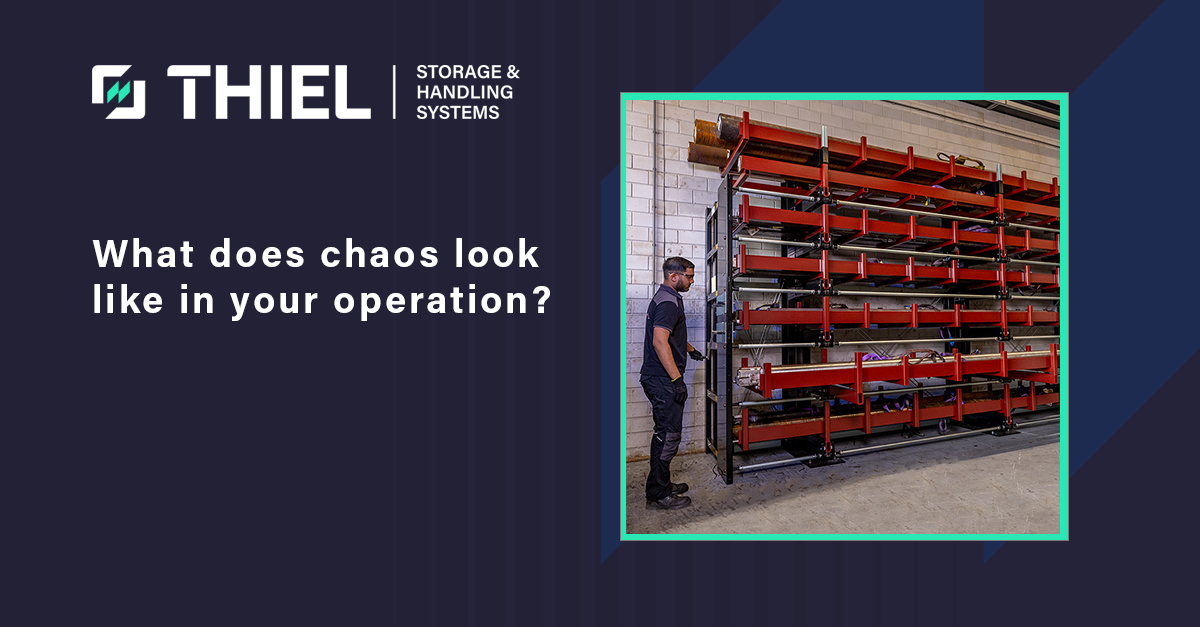
No two companies work exactly the same way. And neither does their chaos. For one company, it’s long materials taking up valuable floor space. For another, it’s heavy loads that are difficult to access. Too many forklift movements, too much searching, or simply too many steps between storage and production. What looks like a storage problem is often a handling problem as well. Because storing material is only half the story. The real question is what happens when you need it. How quickly can it be accessed? How many movements does it take to get it where it needs to go? And can it be handled safely and efficiently? Even companies working with the same materials can have completely different workflows, spaces and requirements.
When does handling become a problem?
Chaos isn’t always something you can see. A warehouse can look perfectly organised and still have an inefficient material flow. If employees have to move other materials first, wait for a forklift or make unnecessary movements to access what they need, valuable time is lost with every handling step.
And efficiency is only part of the equation. Handling heavy or long materials requires control. Poor accessibility can mean more lifting, manoeuvring and internal transport than necessary. The more handling moments a process requires, the more important it becomes to think about safety and ergonomics as part of the storage solution.
That’s also why there is no single answer. A company storing long steel profiles may need something completely different from a company handling heavy components. Limited floor space creates different challenges than a production environment where materials need to be accessed continuously throughout the day. Frequency of use, weight, dimensions, available space and the route towards production all influence what efficient handling looks like.
The right question is therefore not simply: How can we store more? It is: How can storage make the entire process work better?
What if storage could improve your flow?
In intralogistics, storage is never the final destination. Materials arrive, wait and move on towards production. The question is whether the storage system supports that journey or interrupts it.
THIEL develops storage and handling systems for materials that are moved by crane. By matching the storage configuration to the lifting process, materials can be picked directly from their storage position and transferred to where they are needed. Storage and handling become one connected operation.
There is no single system that suits every flow. The right solution depends on the materials, the crane, the building and the way production is organised. Sometimes the priority is capacity. In other cases, it is direct access, shorter routes or a better connection between the storage area and the workplace.
That is why THIEL looks beyond the rack itself. We examine how materials enter the operation, where they need to go and what happens in between. Based on that flow, we develop a system that works with the process instead of forcing the process to adapt to the storage.
Every operation has its own combination of materials, people, space and processes. That means every company has its own kind of chaos. Understanding where that chaos occurs is the first step towards choosing the right way to handle it.
Because the goal isn’t simply a tidier warehouse. It’s a safer, smarter and more efficient flow from storage to production.
Different chaos requires different handling. THIEL beats chaos.
Read more
19 January 2026
NewsTHIEL to Exhibit at A&T – Automation & Testing 2026 in Torino
Read the full story
15 January 2026
Other